Advisory billing
Fees calculated per household from real balances, with every tier and proration shown.

Advisory fees look simple until you have three hundred households on four schedules with mid-quarter contributions. The arithmetic is where advisors lose money quietly, and it is also where a regulator looks first.
Fees are computed from account balances on the valuation date, applied through the household's schedule, prorated for anything that moved mid-period. Tiered and flat schedules both compute, and a tiered schedule shows each band separately rather than presenting one blended number.
Where everything sits
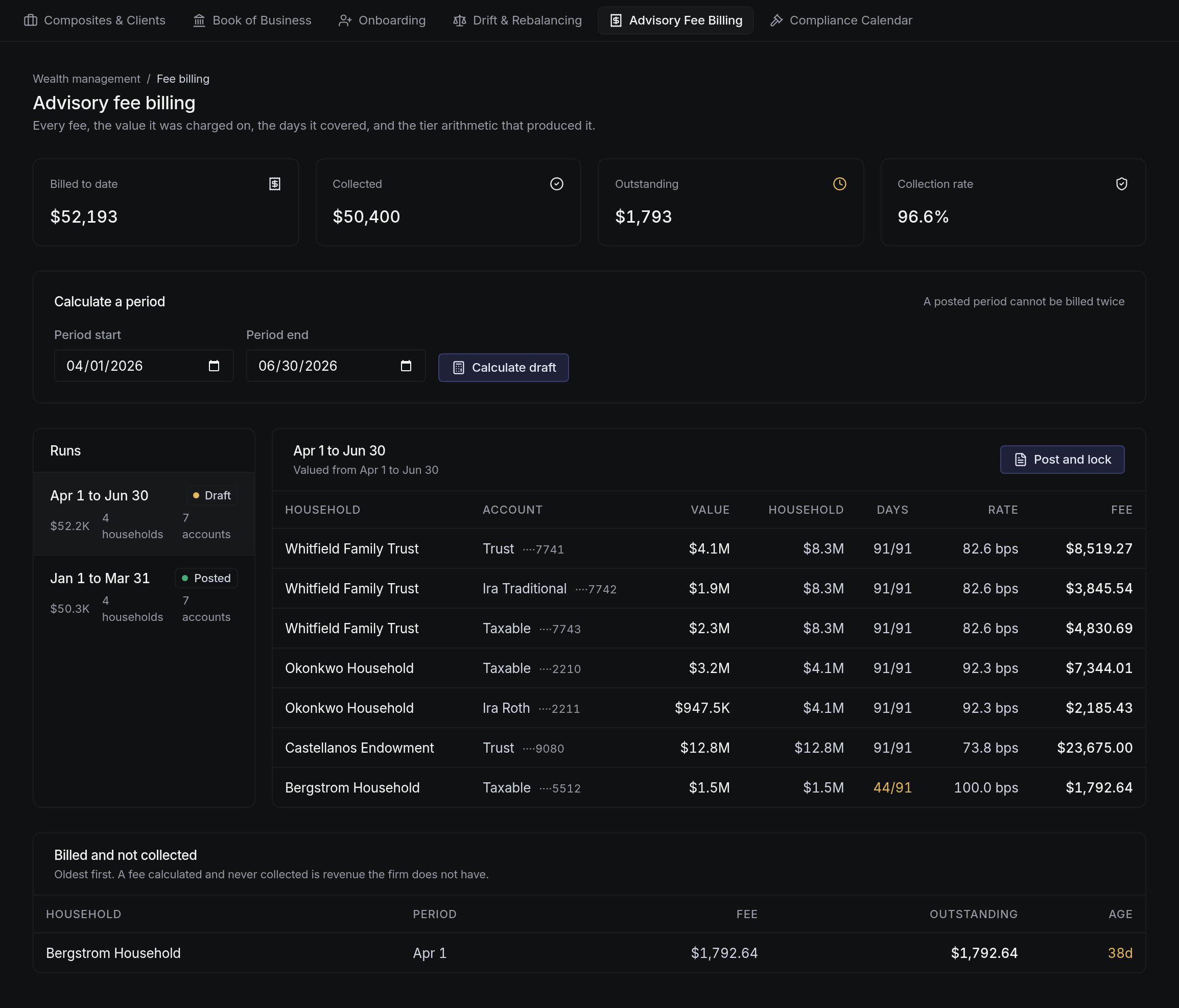





How to work this page
Tiered or flat, the basis, the valuation convention, and the billing frequency. Households can differ and most books have several schedules running at once.
Valuation date balances pull from custodial data. Every household calculates and the run shows the total before anything is charged.
A contribution or withdrawal mid-period prorates by days. The calculation is shown per household, not just the result, because that is the line a client questions.
The run stops for review. Households with an unusual movement against the prior period are surfaced first.
On a phone
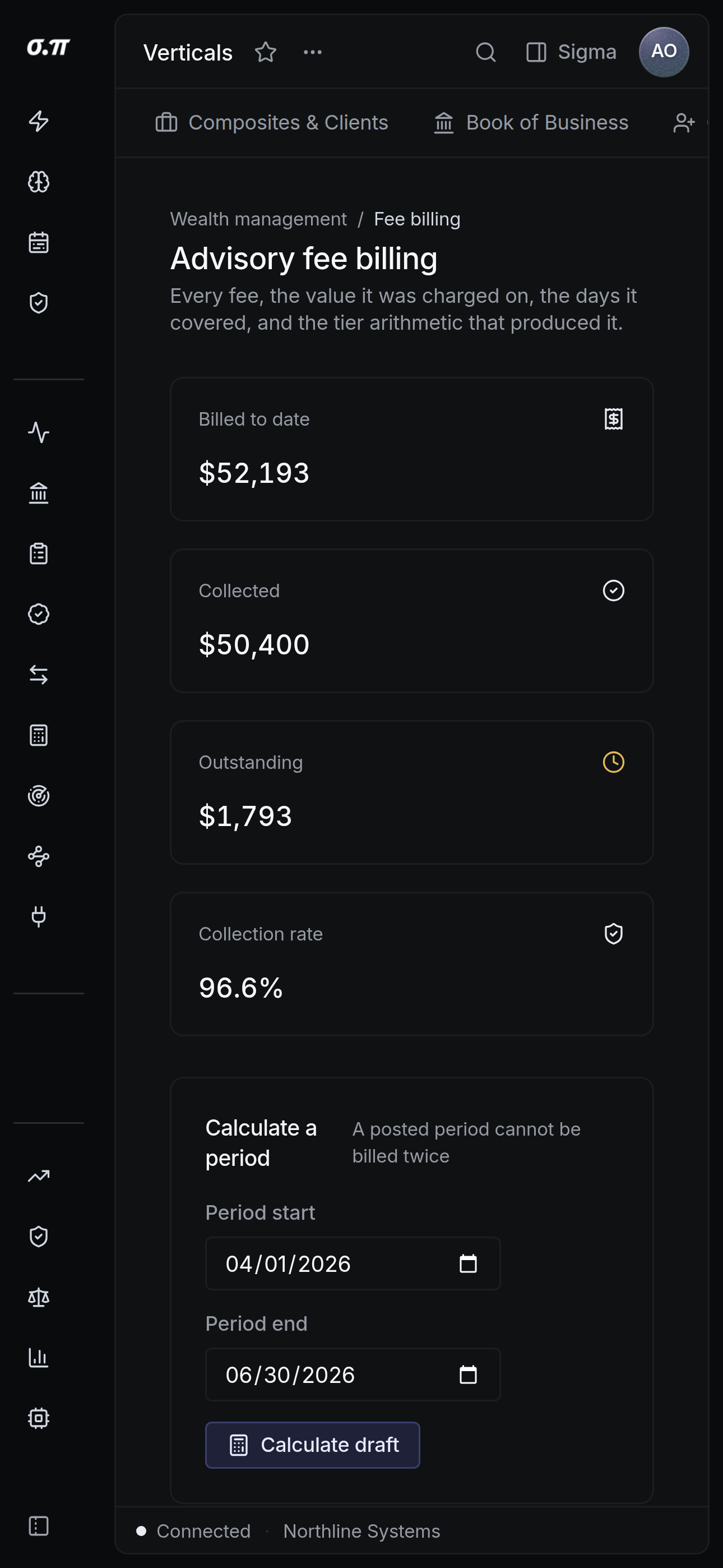
Every figure from the desktop appears here, stacked rather than reduced. Tables scroll inside themselves so the page never moves sideways, and figures keep their separators and their alignment at every width.
Questions people actually ask
Marginally by default, so each band charges its own rate on the portion of assets inside it. A flat schedule applying one rate to the whole balance is a separate setting and is labelled as such, because confusing the two changes the fee materially.
Both conventions are supported per household. The valuation date and the period being charged are stated on every calculation so there is no ambiguity about what a fee covers.